


Three editors of The Montage take on DC
BY: LINDSEY UNNERSTALL
Sports Editor
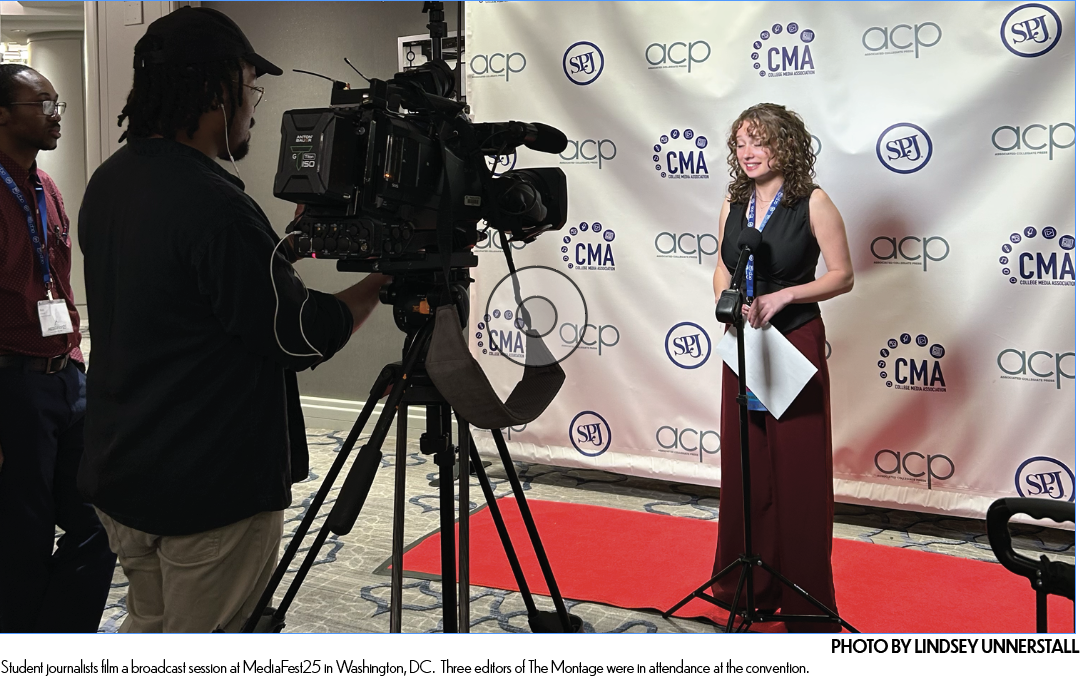
MediaFest 25, the nation’s largest media convention for professional and collegiate student journalists, took place in Washington, D.C. from Oct. 15-18. The event was sponsored by the Associated Collegiate Press, College Media Association and Society of Professional Journalists, consisting of over 200 sessions on different journalistic topics.
With sessions focusing on ethics, photojournalism, networking, landing jobs and negotiating salaries, there was something to offer for every student, adviser and professional alike.
“I think there’s a lot that you can learn from other people, especially in journalistic writing. I think there’s always something you can be learning and seeing and doing,” said Jolie Shultz, art and culture editor for the Kansas State Collegian.
The learning doesn’t stop at the college level for people like Sacha Bellman, adviser at Miami University Ohio and treasurer of the College Media Association (CMA). From attending college media conferences when she was in college to returning as an adviser and board member, the excitement to learn never ends.
“[One] of my favorite things about conventions is that it really helps you be reinvigorated into what you do,” Bellman said. “College Media Association has given so much to me and my job as a student media adviser. I’d like to help people that are new and students and advisers learn more about journalism and be excited.”
Professor of photojournalism at Rochester Institute of Technology (RIT), Josh Meltzer felt the same energy and enthusiasm for teaching at the conference as others felt about learning.
“I think whenever I’m around students and I see that they have this passion for doing this work, it definitely gives me some hope that there is some way to turn this corner, which we really have to do,” Meltzer said after his session on photojournalistic ethics. “We have to say, this is important. We have to make sessions and say this stuff out loud and write things about it, and we have to somehow convince our audiences that we do follow ethics,” said Meltzer.
Martin Smith-Rodden, associate teaching professor at the Ball State School of Journalism, was on the panel about photojournalistic ethics with Meltzer. Along with a journalistic background, Smith-Rodden also completed a Ph.D. in applied experimental psychology, which makes him a media psychologist. This influenced his focus in the session on “The Concerned Photographer,” a phrase created by Cornell Capa to describe photographers who demonstrate their work in a “humanitarian impulse,” which Smith-Rodden emphasized to have empathy and ethics in a world of ever changing media and photojournalism.
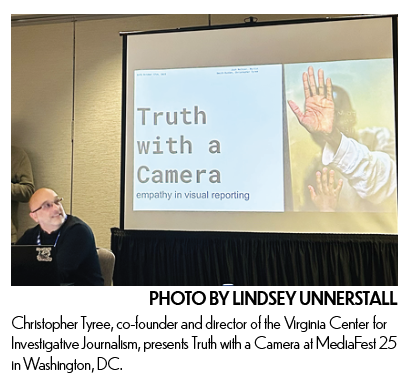
“The topic is something I’m very passionate about. So for my students who are in the photographic storytelling sequence here at Ball State, they hear a lot about the concerned photographer. They get to a point where they’re finishing [my] sentences for me,” Smith-Rodden said. “I think it’s a really important and powerful model for what visual storytellers do.”
Sessions like those with powerful knowledge about the field of journalism is what Jean Norman, adviser of the Signpost at Weber State University and vice president for membership at the CMA, wanted her students to take home from the conference.
“I’m hoping they learn something that they don’t get from me and that they network, that they kind of hang out with professional journalists and get the sense of what it’s going to be like if they choose to go into journalism,” Norman said.
Sure enough, takeaways like that are exactly what Shultz got from Media Fest 25.
“Always be resourceful and always be persistent in anything that you’re trying to cover. There’s always a way to cover something. There’s always stories to be told, and I think we have an ethical right to tell those stories,” said Shultz.
Small moments of connection in the field of journalism are what make conferences like this one so important, according to Meltzer.
“That’s really why you go to these conferences, because [of] those conversations that happen in the hallway or at dinner or something like that,” Meltzer said. “Because you could do these meetings on Zoom and people could present on Zoom, but it’s the stuff that happens after the meeting, where you really make an impact, where you can have an in-depth conversation, and that only can happen by being there in person.”