
By Caleb Carr
Staff
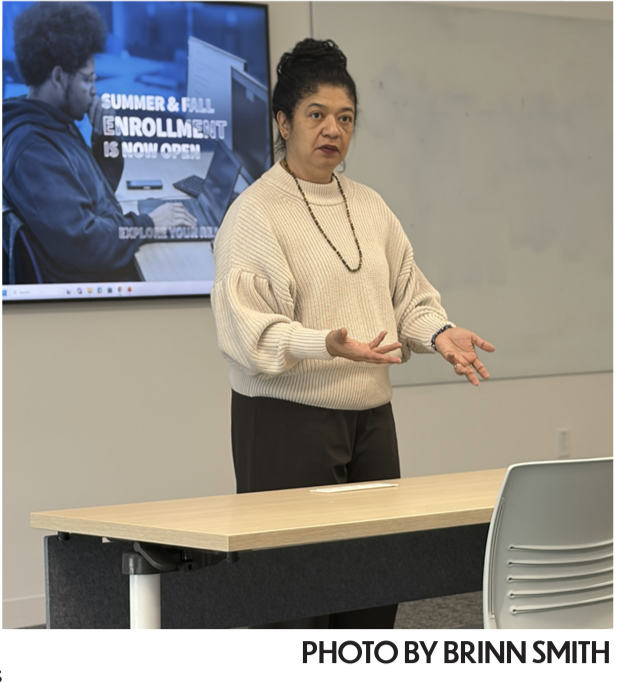
On March 25, Dr. Ana Cruz gave a presentation about her book “Culture, Deafness & Music: Critical Pedagogy and a Path to Social Justice.” The book covers the arts of deaf people along with the unique language of ASL.
Cruz began her presentation by discussing the background behind the book.
“Everything that you see available today with this book, it was because I teach,” Cruz said.
The book comprises everything she has taught and learned in her 25-year career at STLCC. Cruz’s goal with her book was to bring more awareness to the Deaf community and for people who can hear to understand more about Deaf culture than they did before.
Cruz talked about whether Deaf culture is real, and the answer is yes: Deaf people have a very diverse culture with its own history, etiquette, rules and ways of communicating. Many people believe that Deaf culture is all the same, but Cruz discussed the geographic diversity of the community.
“Just because people are deaf doesn’t mean they don’t have other identities other than being deaf, there is a race and a form of resistance “highlighting identity and a gender identity,” Cruz said.
Cruz mentioned that there are sign languages other than American, including French, German and Portuguese. ASL is not a universal language, but it has many forms around the world.
Coming back to the rich culture of the Deaf community and the arts, Cruz said that the book really took off when art was introduced, and it became a focal point of the book. Art is very close to Cruz’s heart, as she is an artist and grew up with it. Deaf artistic expression is often political, according to Cruz, and a form of resistance “highlighting hegemonic relationships and oppression brought about by the hearing world.”
There are many forms of Deaf art, including Deaf Humor, Deaf Poetry, Deaf Theater, De’VIA (Deaf View/Image Art), Signed Music, and Music (performance and private activity). De’VIA is a form of art where deaf people express themselves and their experiences.
Music is also a big part of the Deaf community, with deaf people using music to express themselves. Cruz presented a performance by Ian Sanborn, called, “The Rooster Seeks Music.” Sanborn used a form of visual sign language to tell a story focused on imagery, rhythm and characterization.
Art is a form of physical poetry. Along with the physical art of Sanborn, there is also another form of music that deaf people use to express themselves, and that is rap. Cruz presented a song by Signmark, a deaf rapper whose song “Talk to the Hand” critiques audism and asserts Deaf pride.
Although the Deaf community has made many great strides, there are still things holding them back, according to Cruz, including oralism, audism and ableism as systemic barriers. Cruz mentioned critical pedagogy (an educational philosophy that empowers students to critically examine social inequalities and take action toward social justice) as a way to push back against oppression.
Cruz’s presentation hoped to leave the audience with a shift in perspective: deafness is not defined by absence, but by identity, culture and expression. Through language, art and community, the Deaf experience reflects a rich and complex world that challenges common assumptions. By encouraging greater understanding and the use of critical pedagogy to confront inequality, Cruz’s work calls on society to move toward inclusion, equity and a deeper respect for Deaf culture.