





Suzgo Chitete discusses his work and his passion for journalism with students
By: Elizabeth Cleary
Managing Editor
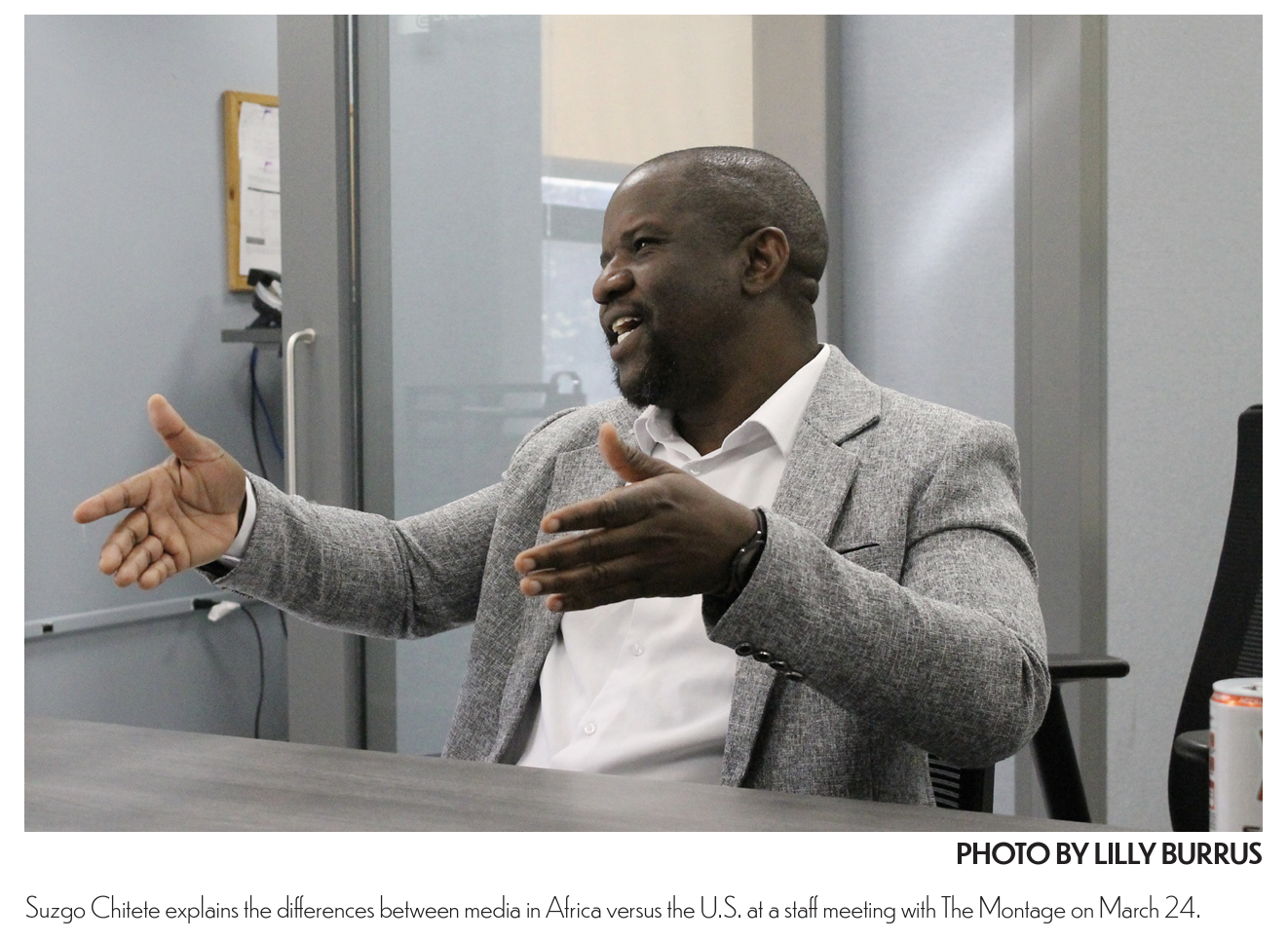
Award-winning investigative journalist Suzgo Chitete from Malawi, Africa, visited the STLCC Meramec campus and newsroom on March 24. With over 16 years of experience in broadcast, print and online media, he talked with “The Montage” staff and editors as well as the college’s Journalism I class.
Chitete discussed how he first got involved with investigative journalism.
“My first experience was working for the public media, but let’s call it the state controlled media. That was my main full time job, but I began working for community radio, which was called Radio Islam… Then I joined a private media house in Malawi, and I was given an opportunity to investigate,” Chitete said.
In his line of work, Chitete has run into controversial and ethical complications, navigating them not without some difficulty.
“My media house… survives on advertising. And what that means is when we’re writing stories, we really have to be careful. I’ve learned to avoid certain stories. We don’t want to do those stories because eventually we are antagonizing the hand that feeds us,” Chitete said.
While Chitete is careful about which stories he writes and what information he discloses, he also takes risks in his work.
“There’s one story that still stands out. I did a story about students who could not get into a university because the system was unfair. When I reported about it, the president became very mad. She accused me of being an agent of the opposition, that I want to bring the government down,” Chitete said. “But the good thing is, the two people that I wrote about, they got admitted into the university, and the government made a decision to end the system that really was unfair to get people into the university. That’s the power of journalism.”
To Chitete, investigative journalism is for everyone. “Every journalist, I think, is an investigator in one way or another. If you read ‘The New York Times,’ you see that they have done big investigations,” Chitete said. “But for me, even if it’s just an interview that you do with somebody, if it’s more probing, it’s investigative in nature. I mean you can do it [investigative journalism] in that small way. Just have passion.”
Chitete feels that the journalism system in America is important and should be taken advantage of by student journalists.
“You could be the next big thing… because it’s possible to do cool journalism here [in America] with minimum threats. And as a public college, the students have a lot of protections as well,” Chitete said. “We are very fortunate that the administration does not censor any of the student newspapers on the campuses. I think it’s a great system.”