

A spectacular performance of a revolutionary play
By: Greta McGlawn
Graphic Design Editor
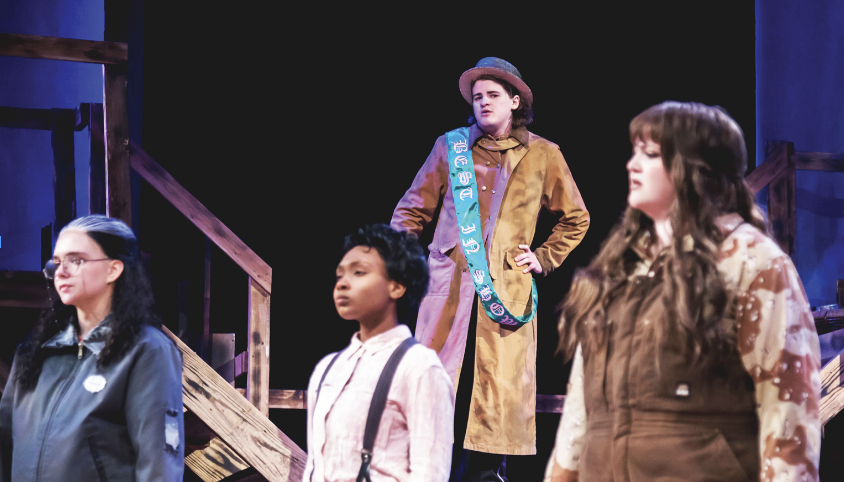
The Meramec Theatre performed “Animal Farm” adapted by Nelson Bond, which follows the plot and ideas from the book “Animal Farm” by George Orwell. Directed by Kayla Lindsay, the cast and crew worked with limited props and costumes to depict the story. The performances were April 15 through 18 with a matinee on April 19.
The cast consisted of seven actors each playing one of the main characters but also playing other minor roles and narrating the story. Around half of the play consisted of backstory and context that was narrated by one actor while the rest changed character and enacted the dialogue.
The actors changed characters with limited costume changes and props. The few props used were for added effect, such as a whip and ribbons. The actors had to rely on body movement and vocal changes to portray different characters, which showed everyone’s talent. Even the set was very simple and just had the necessary elements. Such simplicity put emphasis on the story and concepts being described by the play.
Nelson Bond’s adaptation follows George Orwell’s 1945 book closely, describing the shortcomings of the Russian communism journey through a story about anthropomorphic animals. The tragic tale of revolution and freedom morphing into something warped and evil is told with the use of satire and slapstick. The characters in the book represent the different classes of humans and, some more specifically, factions of the Russian Communist Parties. For example, the three main pigs, Old Major, Napoleon and Snowball are allegories of Karl Marx and Vladimir Lenin, Joseph Stalin, and Leon Trotsky (respectively). The other main pig, Squealer, is an allegory for the most popular newspaper during that time, which spread propaganda according to Stalin (Napoleon). Mr. Jones is the farmer, who is human, and represents more specifically Tsar Nicholas II, but he also represents the concepts of monarchy and dictatorship.
Throughout the story, Napoleon starts to become “human-like” and takes on a role similar to Mr. Jones, just like when Stalin takes over and becomes a dictator. The workhorses represent labor workers, and the show horse, Mollie, represents individuals who left Russia after the revolution. The sheep represent people who “blindly followed” whoever was in charge. Each group of animals has an important part to play — even if just a mention. Breaking down the book, or play, shows how insightful George Orwell was of the whole situation that transpired in Russia and the neighboring “farms.”